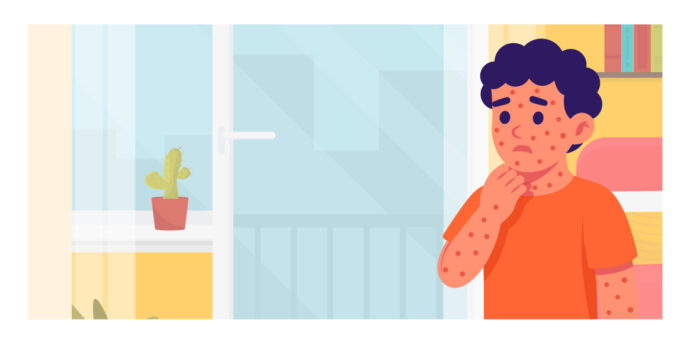
Your child woke up one morning. Usually, he is the one bouncing into the room asking for breakfast, but today he seemed quiet. You noticed a few red bumps on his forehead, one near his neck and when you lift his shirt, there were a few more small red dots.
“Daddy, I feel tired,” he said. You touched his forehead. Slightly hot. You gave him some breakfast – he took a few bites and said he didn’t want anymore. You gave him some paracetamol and asked him to rest. Later towards the afternoon, more spots appeared, some turning from red bumps into tiny fluid-filled vesicles. “Ah, chicken pox,” you said.
Chicken pox or medically known as varicella is caused by the highly contagious virus called varicella-zoster virus. It spreads through respiratory droplets, direct contact with the vesicle fluid, or touching contaminated objects and surfaces. Common symptoms include fever, fatigue, loss of appetite, and the characteristic itchy skin rash that begins as small red dots on the face, body, and limbs, and progresses into small fluid-filled vesicles and eventually the formation of scabs.
The good news is, in an otherwise healthy child, chicken pox is usually a self-limiting disease. This means that in most children, this infection runs its course and resolves on its own without causing lasting problems. It may take a few uncomfortable days, but with rest, fluids, and care, their bodies know exactly how to fight the virus and heal.
What should you do when your child develops chicken pox?
- Keep your child at home until all blisters have crusted over and no new ones forming. This usually takes about one to two weeks after the rash starts.
- Ensure that they are properly hydrated. Offer plenty of fluids in the form of water, milk, soups, or juices, and feed them some easy-to-digest food if they can tolerate it.
- Give paracetamol for their fever and discomfort.
- For their itchy skin, you may apply some calamine lotion or give them cool baths. Dress them with loose clothing so that they feel more comfortable. If they have severe itch, visit a doctor for some antihistamines.
- Ensure proper hygiene by frequently changing their clothes and encourage frequent hand washing.
- Antiviral medications are generally not needed for healthy individuals, but in severe cases or if your child is immunocompromised (cancer patient, taking immunosuppressive medications, immune deficient), bring your child to the doctor to receive an antiviral drug called acyclovir.
- If you need to bring them to the clinic or hospital, please inform the clinic or hospital staff immediately. You and your child will be placed in a separate room away from other patients and will be attended to as quickly as possible to limit the risk of transmission of the disease.
Remember: Many people visit the hospital, and you never know which child is immunocompromised or is suffering from chronic illnesses. It is not just about your child’s recovery, but also about protecting others in the community.
What parents should not do?
- Do not give aspirin because of the possible risk of Reye’s syndrome. Paracetamol may be given for fever control.
- Avoid scratching because this can break the skin and lead to secondary bacterial infection. Scratching also delays healing and increases the risk of permanent marks. When a child scratches, the fluid from the vesicles which contains the virus can get onto their fingers and under their nails. From there, it can spread to other parts of their own body or can be transferred to surfaces, toys, and other people through touch. Encourage gentle patting instead of scratching. You may need to trim your child’s nails short or use mittens at night.
- Do not send them to nursery or school, and do not bring them to crowded places until all blisters have crusted over. Chicken pox is highly contagious and easily transmitted to other students or adults. While most healthy children recover well, chicken pox infection can be very serious and even life-threatening for certain groups including children who are immunocompromised (e.g. those on chemotherapy or long-term immunosuppressive medications), children with chronic disease, and pregnant women who are not immune. You may not always know if another child is immunocompromised, so staying home helps prevent outbreaks and protect vulnerable individuals in the community.
When to seek medical attention
- When your child has an extremely high fever that does not respond to paracetamol.
- Your child has a severe headache, has a stiff neck, and is feeling dizzy or confused.
- If your child cannot tolerate fluids or cannot keep anything down due to vomiting and looks dehydrated.
- If the rash shows signs of bacterial infection (intense tenderness, very red, feels warm, or leaks pus).
- Your child has trouble breathing.
- If your child is a newborn (less than one month old).
- If your child has a weakened immune system.
Prevention is the best medicine
Although chicken pox is often a self-limiting disease, it may cause a lot of discomfort, loss of school days, and disrupts parents’ routine. You may consider chicken pox (varicella) vaccine for your child to prevent them from getting chicken pox. Although chicken pox vaccine is not yet compulsory and not part of Malaysia’s National Immunisation Program, parents can access it from GP clinics and most private paediatricians’ clinic.
References:
• https://medlineplus.gov/chickenpox.html
• https://www.aad.org/public/everyday-care/itchy-skin/rash/chicken-pox
• https://www.cdc.gov/chickenpox/about/index.html
• https://www.mayoclinic.org/diseases-conditions/chickenpox/symptoms-causes/syc-20351282